How do you get ChatGPT to mention you? 3 steps so AI can read you, cite you and hire you
A couple of months ago ChatGPT had no idea who I was; now it sends me visitors. Here is what I did on my site, in three steps and with the files to copy, plus what still doesn't work.
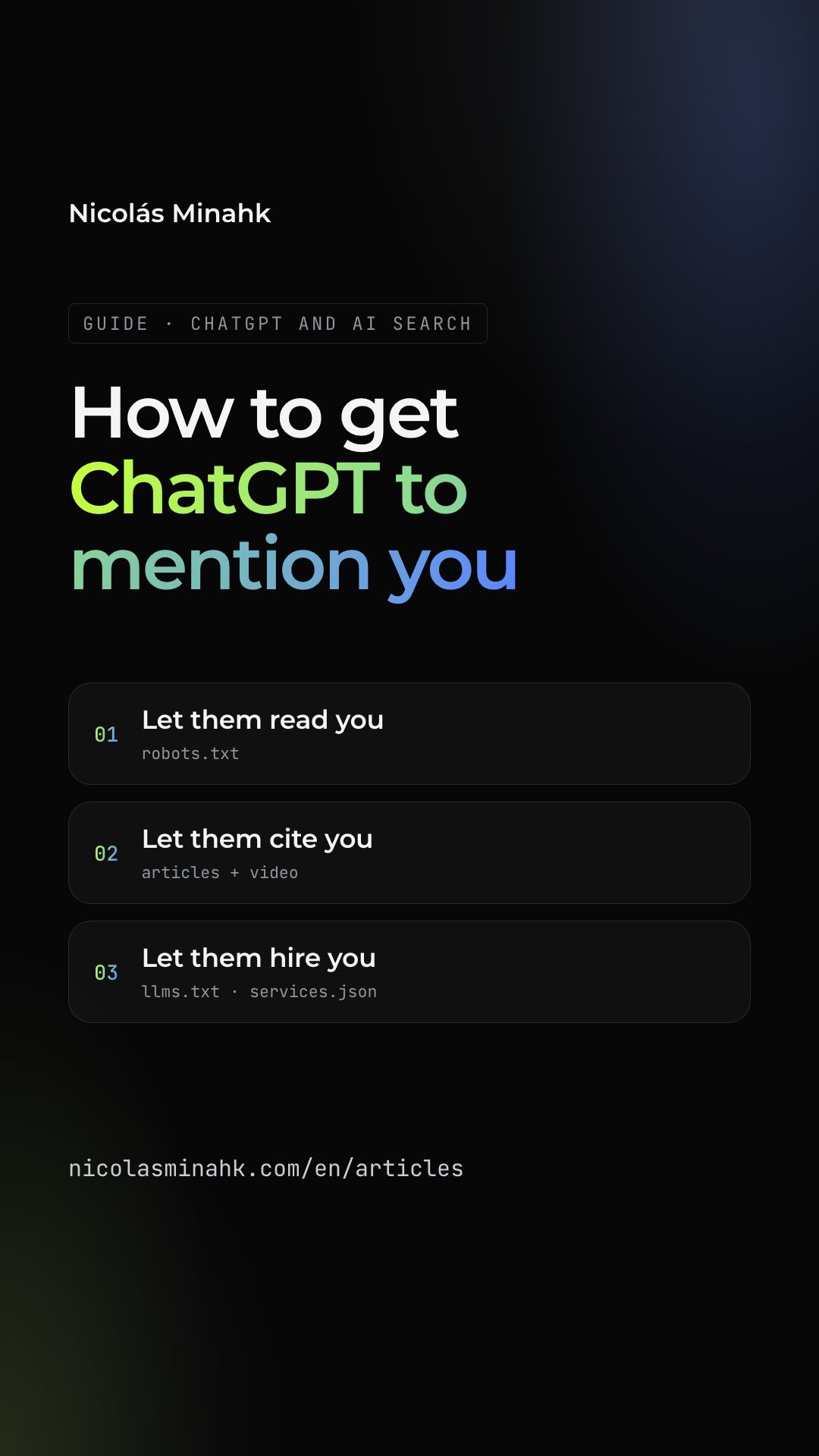
ChatGPT and AI search engines recommend you when they can read your site, understand which problem you solve and find your information repeated in several places. It takes 3 steps: 1) let them read you (a robots.txt that lets OAI-SearchBot in, no Cloudflare blocks, and your site indexed in Bing); 2) let them cite you (clear articles that solve a problem, with a question as the title, plus video and social); 3) let them hire you (llms.txt and services.json with your services and prices and, if you want, a payment protocol for agents). At the end there is a prompt so Claude does it on your site.
What happened to me
A couple of months ago, if you asked ChatGPT about me, it had no idea who I was. Now it sends me visitors.
In Plausible, over two weeks, ChatGPT brought me 24 visits from 16 people who didn't know me. The way in was the article How to connect After Effects to Claude.
It's not paid advertising: I pay OpenAI nothing for ads. It's indexing and recommendation. 24 visits isn't a flood, but it's 16 people who showed up without me doing anything beyond publishing something useful and leaving the door open. This is what I did.
Why it matters now
According to Cloudflare, in June 2026 57.5% of web requests were already bots and 42.5% were people (source). A growing share of what “reads” your site isn't a person: it's a program that then answers a person.
And one thing changes how it pays to publish: AI leans more on what others say about you than on what you say about yourself. A page that says “I'm an expert in this” carries little weight. The same topic covered on your site, in a video, on social and in a live stream builds a pattern the model can recognize. That's why it pays to talk about the same topic across formats: web, YouTube, social, live.
Step 1 · Let them read you
ChatGPT searches the web with its own crawler, OAI-SearchBot, and also leans on Bing's index. If your site shuts the door on that crawler, you don't show up in its answers, however good your writing is.
The minimum is a robots.txt at the root of your domain that lets it in:
User-agent: OAI-SearchBot
Allow: /

User-agent: ChatGPT-User
Allow: /

Sitemap: https://yourdomain.com/sitemap.xmlChatGPT-User is the one that comes in when a person asks ChatGPT to open a specific page. The Sitemap line tells it where the list of all your pages lives: swap yourdomain.com for yours. Mine is at /robots.txt.
GPTBot is something else. It's the crawler OpenAI uses to train its models, and it's separate: you can block it without losing citations in ChatGPT search. I let it in on purpose, because I want my work to be part of what the model knows, but that's your call.
Finally, submit your sitemap to Bing Webmaster Tools. It's free, takes a few minutes and is the most direct way for Bing, and through it ChatGPT, to know your pages exist.
Source: Alice Labs, “How to get cited by ChatGPT”.
Step 2 · Let them cite you
Being readable isn't enough: they need to find something worth citing. This is the pattern I follow in every article:
- One concrete problem. Not “AI for creatives”, but “how to connect After Effects to Claude”.
- A question as the title. It's how people ask ChatGPT, and it's what the model is trying to answer.
- 3 or 4 numbered steps. Easy for a person to follow and easy for an AI to summarize.
- Commands or resources ready to copy and paste. What it takes to do it right now, with nothing left to interpret.
- The video with the same information, with the commands in the video description too.
My rule: the conversion isn't the visit, it's solving the problem. I give all the information away on the site, on social and in the descriptions, with nothing hidden behind a course. If someone solves their problem with my article and never writes to me, it still worked.
Two examples of how I apply it: How to connect After Effects to Claude and edit video by talking to it and How to connect Claude to Premiere Pro in 3 steps. This article follows the same recipe: a question as the title, a short answer up top, three steps, files to copy and a video.
Step 3 · Let them hire you
This step isn't about ChatGPT citing you anymore. It's so that an agent, an AI that does tasks for a person such as finding a supplier and asking for a quote, understands what you sell, what it costs and how to hire you.
llms.txt: your site's instruction manual
llms.txt is a text file at the root of your site that works as an instruction manual for the models and agents reading it: what you do, which pages matter and how to hire you, in Markdown and without the design noise.
One honest fact before you get your hopes up: according to an Ahrefs study of 137,000 domains, 97% of llms.txt files didn't get a single request in May 2026 (source). It's not a trick to show up in ChatGPT search. It's for agents, and for AI search engines like Bing. I have one anyway: it takes an afternoon and, when an agent shows up, it will find everything in order.
What goes inside, in four blocks:
- What you do, for whom and from what price.
- Cases and proof, with concrete results.
- Guides: the articles that show how you work.
- How to hire you: services, prices and human contact (form, email, WhatsApp).
This template has all four. Copy it and replace each line with yours:
# Your business name

> What you do, for whom and where, in two lines. Starting price if you have one.

## Services
- [Service 1](https://yourdomain.com/service-1/): what you deliver, timeline and starting price.
- [Service 2](https://yourdomain.com/service-2/): what you deliver, timeline and starting price.

## Cases and proof
- [Client case](https://yourdomain.com/case/): the result in one line, with a number.

## Guides
- [Your best article](https://yourdomain.com/article/): the question it answers.

## How to hire
- Contact email and WhatsApp
- Form: https://yourdomain.com/contact/
- Catalog for agents: https://yourdomain.com/services.jsonservices.json: the catalog a machine reads
services.json is your catalog in a format a machine reads without guessing: each service with its id, name, what it includes, timeline, price and payment methods. One service looks like this:
{
  "id": "consulting-1on1",
  "name": "1:1 consulting",
  "price": { "amount": 100, "currency": "EUR" },
  "delivery": "60 min",
  "payment": ["stripe", "x402"]
}x402: letting an agent pay you
x402 is a protocol for an agent to pay you. The agent requests the service, your site answers 402 (“Payment required”) with the price, the agent pays in USDC on the Base network and gets its order number.
I'll tell it as it is: on my site it's set up, but paused while I review European regulations (I'm in Spain). In other countries it may be simpler. And no agent has hired me yet. But the sooner your catalog is ready, the better.
What's most common today: the person pays with Stripe and the agent, with a protocol. You don't have to pick one.
My site, as a real example
- The Human / Agent button in the footer of the home page: it switches to the view an agent reads.
- /llms.txt: the manual for models and agents.
- /services.json: the catalog with timelines and prices.
- /en/agents/: the explanation, for people, of how an agent hires me.
How to tell if it's working
ChatGPT adds utm_source=chatgpt.com to the links it sends, so it shows up in your analytics as one more source. That's how I saw the 24 visits.
And to wrap up, test it yourself: open ChatGPT in an incognito window and ask what you do, or what your business does.
The prompt: let Claude do it for you
If your site lives in a repository and you use Claude Code (or any coding agent), copy this prompt and paste it with Claude open in your project folder. It will review your site, ask you the questions it needs and build everything. Before publishing, it shows you a summary of the changes.
You are a web developer who specializes in technical SEO and in getting sites ready for AI search engines and agents. You are working inside my website's repository. Your goal is for ChatGPT and other AI search engines to be able to read my site, understand what I do and recommend me, and for an agent to be able to see my services and hire me. Work in this order and do not publish anything without first showing me a summary of the changes.

1. Diagnosis. Detect the framework, how the HTML is generated (static, SSR or client-side JavaScript only), where root files are served from, whether there is a sitemap and whether robots.txt, llms.txt or any service catalog exists. If the content only appears after JavaScript runs, tell me, because many crawlers will not see it, and propose how to fix it.

2. Questions. Before creating any content, ask me in a single message for whatever you cannot get from the site: business name, what I do, for whom and in which area; my services with what each one includes, timeline and price or starting price; real cases or results with numbers; my best articles or guides; how I prefer to be contacted (form, email, WhatsApp) and whether I want to take payments online (Stripe or other). Do not make up prices, cases or data: if I do not give them to you, leave that part out.

3. robots.txt. Create or update /robots.txt to explicitly allow OAI-SearchBot and ChatGPT-User, keep any rules that already exist and add the Sitemap line with the absolute URL. Ask me whether I want to block GPTBot (training) and explain that blocking it does not remove me from ChatGPT search. Also check that there is no meta robots noindex and no X-Robots-Tag header blocking important pages.

4. External blocks. If you detect Cloudflare or another CDN or firewall (through configuration, headers or DNS), tell me to check the "Block AI bots" option and the managed robots.txt, and explain step by step where to turn them off. Do not touch any configuration outside the repo.

5. Sitemap. Make sure /sitemap.xml exists with every public page and its last-modified date. At the end, give me the instructions to submit it to Bing Webmaster Tools and Google Search Console.

6. llms.txt. Create /llms.txt in Markdown in this order: a title with the business name; a two-line summary (what I do, for whom, where, entry price); a Services section with the link, what I deliver, timeline and price for each one; a Cases and proof section with concrete results; a Guides section with my best articles and the question each one answers; a How to hire section with human contact, form and the link to /services.json. Every URL absolute and existing.

7. services.json. Create /services.json with an array of services. Each service has an id in kebab-case, name, short description, what it includes, the information I need from the client to start, delivery time, price (amount and currency, or "from"), payment methods and the URL of the service page. Serve it with Content-Type application/json and validate that it is valid JSON.

8. Structured data. Add Organization JSON-LD (or Person if I work alone) on the home page and Service JSON-LD on each service page, consistent with services.json. If there are FAQs, add FAQPage. Validate that it does not break the HTML.

9. Page for agents (optional, ask me). Propose an /agents/ page that explains in human language how an agent can see my services and request a quote from me, linked from the site footer next to llms.txt and services.json.

10. Payments for agents (optional, only if I ask). Explain what x402 is and what it would take, and warn me that I first need to check my country's regulations before taking payments in crypto. Do not implement it without my explicit confirmation.

11. Citable content. Review my pages and articles and propose up to 5 concrete improvements so an AI can cite them: question-style titles, a short answer at the top, numbered steps, resources to copy and internal links. Also propose 3 ideas for new articles based on the questions my clients probably ask ChatGPT.

12. Verification. When you finish, check locally or in production that /robots.txt, /llms.txt, /services.json and /sitemap.xml return 200 with the right content type. Give me the curl commands to check it myself and a final checklist of what is done and what is pending. Remind me that I can measure results by looking for visits with utm_source=chatgpt.com in my analytics, and that I can test it by opening ChatGPT in incognito and asking what my business does.Is your site not in a repo (Wix, Squarespace, managed WordPress)? Write to me and we'll work through it in a 1:1 consulting session (held in Spanish).
Resources
- My llms.txt: nicolasminahk.com/llms.txt
- My services.json: nicolasminahk.com/services.json
- My page for agents: nicolasminahk.com/en/agents/
- Bing Webmaster Tools: https://www.bing.com/webmasters
- Bots and people on the web, Cloudflare data (exchange4media): https://www.exchange4media.com/digital-news/ai-is-now-both-creator-and-consumer-155354.html
- How to get cited by ChatGPT (Alice Labs): https://alicelabs.ai/en/insights/how-to-get-cited-by-chatgpt
- The Ahrefs study on llms.txt (PPC Land): https://ppc.land/llms-txt-adoption-rises-8-8x-but-97-of-files-get-zero-ai-requests/
- The video for this article (in Spanish): Cómo lograr que ChatGPT te recomiende: 3 pasos para que la IA te lea, te cite y te contrate
Frequently asked questions
Do I have to pay for ads on ChatGPT to show up?
No. This is indexing and content, not ads. I pay OpenAI nothing: the visitors ChatGPT sends me arrive because it found my page, understood what it solved and cited it in an answer.
Does llms.txt make ChatGPT cite me?
Not on its own. llms.txt is for agents and for some AI search engines such as Bing. For ChatGPT search, what weighs more is that the crawler can get in (robots.txt and Cloudflare), that you are indexed in Bing and that you have content worth citing.
Does blocking GPTBot take me out of ChatGPT?
No. GPTBot is OpenAI’s training crawler and is separate from search. What you must not block is OAI-SearchBot, which ChatGPT search uses, and ChatGPT-User, which comes in when a person asks it to open a page.
Do I need to take payments in crypto?
No. x402 is optional. Stripe and a form for people are enough to start. I have it set up but paused while I review European regulations.
How long does it take to show?
OpenAI says a robots.txt change takes about 24 hours to be reflected. Citations depend on having useful content and mentions elsewhere, so it is a matter of weeks, not days.
What you just read, running in your team.
I set up Claude and its connectors with your creative or marketing team: video editing, ad variations, product pages and reports. You keep the workflows running and documented.
Rather have me build it for your brand? Start with a diagnosis: we look at your creatives, your store and your team, and I tell you where to begin.
Get a diagnosis for my brandRather a live hour? 1:1 consulting — €100 (in Spanish)